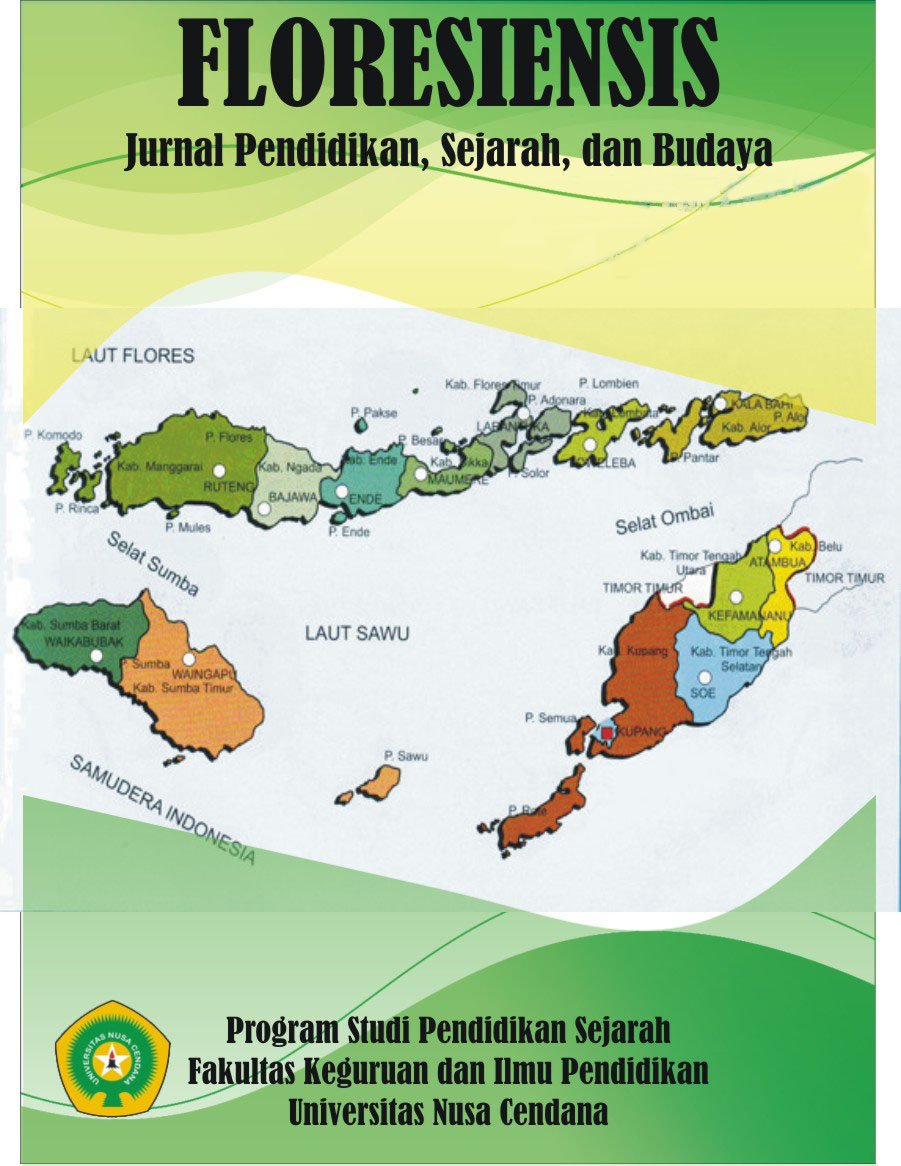
Sejarah Penulisan Manuskrip Al-Qur’an Kulit Kayu di Desa Alor Besar Pulau Alor

-
 Sarifa Aini Usman(1*)
 UNIVERSITAS NUSA CENDANA
-
Djakariah Djakariah(2)
-
Flafius Selfianus Rato(3)
(*) Corresponding Author
Abstract
This study aims to examine the history of writing, the process of its creation, as well as the function and meaning of the Qur'anic manuscripts on tree bark in Alor Besar Village, Alor Barat Laut District, Alor Regency. The study employed historical methods encompassing heuristics, verification, interpretation, and historiography. Data were collected through in-depth interviews, direct observation, and document studies, with purposeful selection of informants. The results indicate that this tradition grew alongside the arrival and development of Islam in the Alor region as a means of da'wah and a center for religious learning. Its creation utilizes locally available natural materials, black and red ink from natural sources, and a Naskhi calligraphy style complete with harakat (sound) signs, tajwid (recitation), and waqf (invocation) for ease of learning. This manuscript serves as a learning medium, a symbol of religious identity, a means of transmitting Islamic values, and a cultural symbol that strengthens the togetherness of the local community.
Downloads
References
Hamid, A., & Madjid, I. (2014). Metodologi Penelitian Sejarah. Makassar: Penerbit Alauddin University Press.
Iskandar. (2008). Metodologi Penelitian Sosial dan Pendidikan. Jakarta: Gaung Persada Press.
Lombard, Denys, Nusa Jawa: Silang Budaya. Kajian Sejarah Terpadu. Jakarta: Gramedia, 1996
Margono, S. (2009). Metodologi Penelitian Pendidikan. Jakarta: Rineka Cipta.
Moleong, L. J. (2004). Metodologi Penelitian Kualitatif. Bandung: PT Remaja Rosdakarya.
Satori, D., & Komariah, A. (2009). Metodologi Penelitian Kualitatif. Bandung: Alfabeta.
Sjamsudin, H. (2012). Metodologi Sejarah. Jakarta: Rajawali Pers.
Suprapto. (2013). Metodologi Penelitian Sejarah dan Penulisan Karya Ilmiah. Yogyakarta: Pustaka Ilmu.
Taha, A. Rahman. Sejarah Islam di Nusa Tenggara Timur. Kupang: Pustaka NTT, 2010.