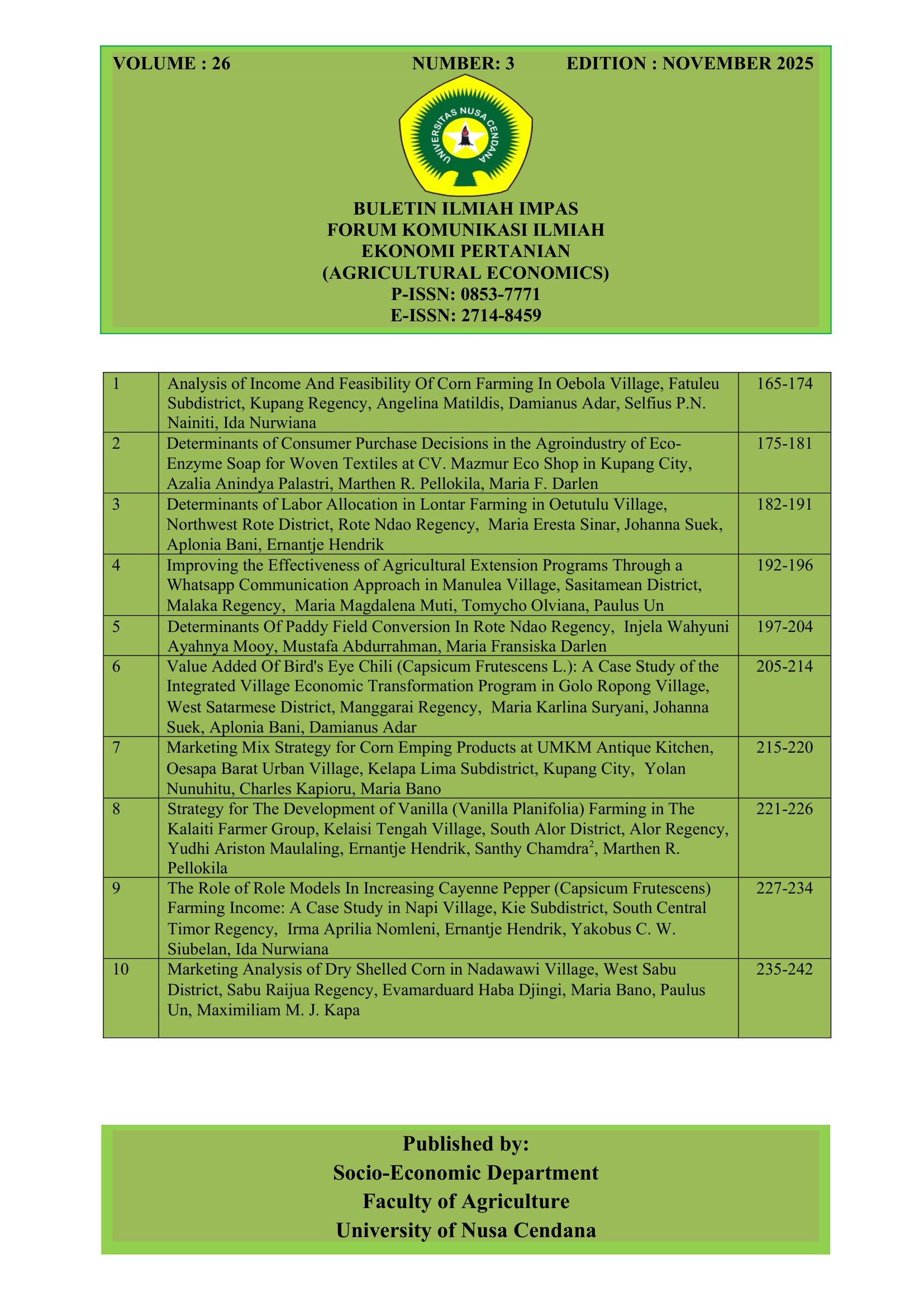
THE ROLE OF ROLE MODELS IN INCREASING CAYENNE PEPPER (CAPSICUM FRUTESCENS) FARMING INCOME: A CASE STUDY IN NAPI VILLAGE, KIE SUBDISTRICT, TIMOR TENGAH SELATAN REGENCY

-
 Irma Aprilia Nomleni(1*)
 Universitas Nusa Cendana
-
Ernantje Hendrik(2)
Universitas Nusa Cendana
-
Yakobus C.W. Siubelan(3)
Universitas Nusa Cendana
-
Ida Nurwiana(4)
Universitas Nusa Cendana
(*) Corresponding Author
Abstract
Cayenne pepper farming is a major source of income for rural communities, including Napi Village in Timor Tengah Selatan Regency. However, farmer productivity and income remain uneven due to limited technical knowledge, weak farmer institutions, and low adoption of innovation. This study aimed to examine the role of local role models (mnasi aleta lene) in increasing farmers' income from cayenne pepper farming. A quantitative approach was employed with 48 farmers selected through simple random sampling. The role model variable was measured using five indicators: mentor, motivator, facilitator, organizer, and communicator. Farmers' income was calculated using farm income analysis (I = TR - TC) and categorized into low, medium, and high levels. The data were analyzed using descriptive statistics and ordinal logistic regression. The results show that average farmer income reached IDR 11,854,937 per planting season, indicating that cayenne pepper farming in Napi Village is profitable. The ordinal regression model was statistically significant (Chi-Square = 27.604; p = 0.001), with a Nagelkerke R2 value of 0.538. Partially, the role model function as a mentor (p = 0.034) and facilitator (p = 0.002) significantly influenced farmers' income, while the roles as motivator, organizer, and communicator had no significant effect. These findings indicate that the economic impact of role models is mainly determined by technical guidance and facilitation of access to resources rather than symbolic or motivational functions alone.
Downloads