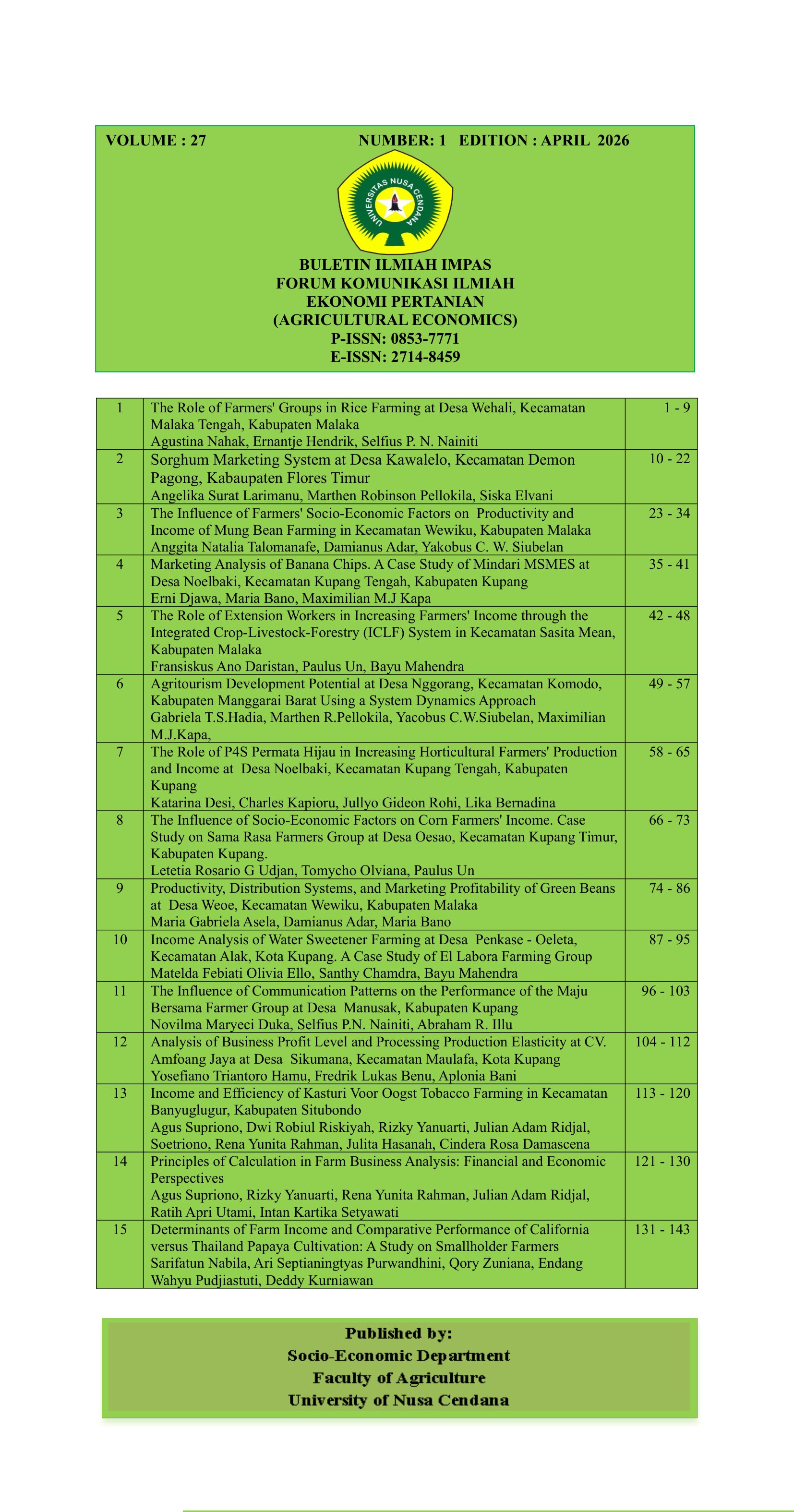
THE ROLE OF EXTENSION WORKERS IN INCREASING FARMERS' INCOME THROUGH THE INTEGRATED CROP-LIVESTOCK-FORESTRY (ICLF) SYSTEM IN SASITA MEAN DISTRICT, MALAKA REGENCY

-
 Fransiskus Ano Daristan(1*)
 Universitas Nusa Cendana
-
Paulus Un(2)
Universitas Nusa Cendana
-
Bayu Mahendra(3)
Universitas Nusa Cendana
(*) Corresponding Author
Abstract
This study aims to (1) determine the role of agricultural extension workers in the implementation of the Integrated Crop-Livestock-Forestry (ICLF) system, and (2) analyze the level of farmers’ income through the implementation of the ICLF system in Sasitamean Subdistrict, Malaka Regency. The ICLF system is an integrated agricultural system that combines crops, livestock, and forestry into a single farming enterprise to improve land efficiency and farmers’ income. This study employed a survey method using a quantitative descriptive approach. The study population consisted of all 70 farmers implementing the ICLF system, with a sample of 35 farmers selected using snowball sampling. The data used included primary data obtained through interviews and questionnaires, as well as secondary data from relevant agencies. Data analysis was conducted using descriptive analysis and income analysis. The results of the study indicate that the role of agricultural extension workers in the implementation of the ICLF system is considered good, with an average score of 3.50 or an achievement level of 70.1%. Most respondents (77.14%) stated that the extension workers played a good role. The average total annual income for farmers was Rp 43,162,856, with average annual production costs of Rp 11,247,051, resulting in an average annual income of Rp 31,915,805. Thus, it can be concluded that the role of extension workers is crucial in supporting the implementation of the ICLF system, and this system has proven.
Downloads