XRD Characterization and Structural Insights of Activated Carbon-ZnO Composite for Potential Photocatalytic Applications

-
 Devi Lestari(1*)
 Industrial Chemical Engineering Technology, Department of Mechanical Engineering, Politeknik Negeri Medan, 20155, Medan
-
Imas Masriah(2)
Industrial Chemical Engineering Technology, Department of Mechanical Engineering, Politeknik Negeri Medan, 20155, Medan
-
Adelia Yesya Putri Hasibuan(3)
Industrial Chemical Engineering Technology, Department of Mechanical Engineering, Politeknik Negeri Medan, 20155, Medan
-
Pina Budiarti Pratiwi(4)
Industrial Chemical Engineering Technology, Department of Mechanical Engineering, Politeknik Negeri Medan, 20155, Medan
(*) Corresponding Author
Abstract
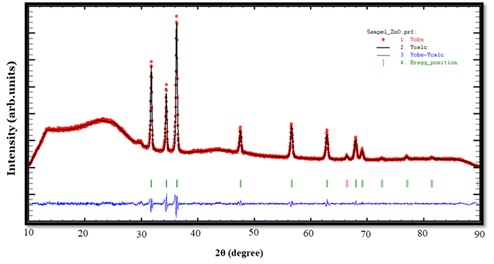
This study presents a structural characterization of an activated carbon-ZnO (AC/ZnO) composite synthesized via a simple sol-gel route using activated carbon derived from oil palm empty fruit bunches (OPEFB), introducing a sustainable biomass based carbon source as a functional photocatalytic support. X-ray diffraction (XRD) analysis revealed sharp diffraction peaks corresponding to the wurtzite ZnO phase, together with a broad amorphous carbon halo, confirming the successful incorporation of crystalline ZnO within the carbon matrix. Microstructural parameters, including crystallite size, lattice strain, and dislocation density, indicate nanoscale structural ordering accompanied by beneficial defect sites that promote charge trapping. Structural interpretation was further validated through Rietveld refinement, which confirmed a single-phase ZnO structure with good fitting quality, demonstrating the structural stability and compatibility of ZnO within the carbon framework. Photocatalytic evaluation using methylene blue showed a higher removal efficiency under natural sunlight (95%) compared to dark adsorption (85%), evidencing a synergistic adsorption-photocatalysis mechanism. The novelty of this work lies in integrating low temperature sol–gel synthesis, waste derived activated carbon, and XRD based microstrain and refinement analyses to establish a clear structure–function relationship in AC/ZnO composites. These findings highlight the practical potential of this material as a low cost, scalable, and solar responsive photocatalyst for sustainable wastewater treatment applications, particularly in resource limited and tropical regions.
Downloads
References
M. Yasmina, K. Mourad, S. H. Mohammed, and C. Khaoula, “Treatment Heterogeneous Photocatalysis; Factors Influencing the Photocatalytic Degradation by TiO2,” Energy Procedia, vol. 50, pp. 559–566, Jan. 2014, doi: 10.1016/J.EGYPRO.2014.06.068.
R. Singh and S. Dutta, “Synthesis and characterization of solar photoactive TiO2 nanoparticles with enhanced structural and optical properties,” Advanced Powder Technology, vol. 29, no. 2, pp. 211–219, Feb. 2018, doi: 10.1016/j.apt.2017.11.005.
X. Zhao, H. Li, and J. Yu, “ZnO-based photocatalysts for environmental remediation: A review,” Appl Catal B, vol. 268, 2020, doi: 10.1016/j.apcatb.2019.118432.
S. Patil, P. Singh, and A. Kumar, “ZnO–carbon composites for photocatalytic degradation of dyes: Mechanistic and structural insights,” Catal Today, vol. 424, 2023, doi: 10.1016/j.cattod.2023.113631.
F. Li, S. Sun, Y. Jiang, M. Xia, M. Sun, and B. Xue, “Photodegradation of an azo dye using immobilized nanoparticles of TiO2 supported by natural porous mineral,” J Hazard Mater, vol. 152, no. 3, pp. 1037–1044, Apr. 2008, doi: 10.1016/j.jhazmat.2007.07.114.
C. Zhang, Y. Zhang, L. Wang, X. Deng, Y. Liu, and J. Zhang, “A health management review of proton exchange membrane fuel cell for electric vehicles: Failure mechanisms, diagnosis techniques and mitigation measures,” Renewable and Sustainable Energy Reviews, vol. 182, p. 113369, Aug. 2023, doi: 10.1016/J.RSER.2023.113369.
J. Wang et al., “Preparation, structural and photocatalytic activity of Sn/Fe co-doped TiO2 nanoparticles by sol-gel method,” Ceram Int, vol. 48, no. 6, pp. 8297–8305, Mar. 2022, doi: 10.1016/j.ceramint.2021.12.034.
S. Mohan, R. Kumar, and M. Pandey, “FTIR and structural studies on ZnO-loaded carbon composites for photocatalytic degradation,” Mater Chem Phys, vol. 271, 2021, doi: 10.1016/j.matchemphys.2021.124841.
M. D. F. Valiyathur et al., “Photocatalytic and toxicity assessment of alginate reinforced ZnO-g-C3N4 photocatalyst for the degradation of methylene blue – A sustainable strategy,” Int J Biol Macromol, vol. 298, p. 139935, Apr. 2025, doi: 10.1016/J.IJBIOMAC.2025.139935.
Z. H. Al Naji et al., “Efficient visible-light-active ZnO/Cs0.33WO3/g-C3N4 double Z-type heterojunction photocatalyst for rhodamine B photodegradation,” Spectrochim Acta A Mol Biomol Spectrosc, vol. 341, p. 126380, Nov. 2025, doi: 10.1016/J.SAA.2025.126380.
R. Yang et al., “MnO2-Based Materials for Environmental Applications,” Advanced Materials, vol. 33, no. 9, p. 2004862, 2021, doi: https://doi.org/10.1002/adma.202004862.
H. Zhang, Y. Liu, and T. Wang, “Enhanced photocatalytic activity of ZnO/activated carbon composites for dye degradation,” Mater Today Chem, vol. 20, 2021, doi: 10.1016/j.mtchem.2021.100478.
R. Yin, X. Luo, and H. Liu, “Interfacial Zn–O–C bonds and charge transport in ZnO/activated carbon nanocomposites,” Surf Coat Technol, vol. 441, p. 128569, 2022.
R. Suresh, S. Rajendran, and S. Thanikaikarasan, “Effect of carbon incorporation on the structural and optical properties of ZnO nanocomposites,” Mater Chem Phys, vol. 242, p. 122495, 2020.
J. Liu et al., “F/W co-doped TiO2-SiO2 composite aerogels with improved visible light- driven photocatalytic activity,” J Solid State Chem, vol. 275, pp. 8–15, Jul. 2019, doi: 10.1016/J.JSSC.2019.03.042.
S. S. Patil, M. S. Tamboli, S. R. Jadhav, and D. R. Patil, “Crystal facet engineering of ZnO for photocatalytic degradation of organic pollutants,” Ceram Int, vol. 49, no. 1, pp. 1428– 1436, 2023.
H. Yin, Q. Luo, and Y. Liu, “Structural and interfacial properties of ZnO/carbon composites and their enhanced photocatalytic performance,” J Environ Chem Eng, vol. 10, no. 1, p. 106845, 2022.
S. M. Hussain et al., “Emerging Aspects of Photo-catalysts (TiO2 & ZnO) Doped Zeolites and Advanced Oxidation Processes for Degradation of Azo Dyes: A Review,” Curr Anal Chem, vol. 17, no. 1, pp. 82–97, 2020, doi: 10.2174/1573411016999200711143225.
H. Samadi, R. Z. Mohgadam, and M. G. Shahraki, “Green synthesis of ZnO nanoparticles, photocatalyst activity and its biomedical applications: A review,” Mater Chem Phys, p. 131161, Jun. 2025, doi: 10.1016/J.MATCHEMPHYS.2025.131161.
Copyright (c) 2025 Devi Lestari, Imas Masriah, Adelia Yesya Putri Hasibuan, Pina Budiarti Pratiwi

This work is licensed under a Creative Commons Attribution-ShareAlike 4.0 International License.
 This work is licensed under a Creative Commons Attribution-ShareAlike 4.0 International License. Copyright is retained by the authors, and articles can be freely used and distributed by others.