Kinetics of Ammonia Biodegradation Using EM4 with Palm Sugar as an External Carbon Source

-
 Denanda Clarasati Puteri(1*)
 Teknologi Proses Industri Petrokimia, Politeknik Industri Petrokimia Banten Jl. Raya Karang Bolong, Cikoneng, Kec. Anyar, Kabupaten Serang, Banten
-
Rizky Ibnufaatih Arvianto(2)
Teknologi Proses Industri Petrokimia, Politeknik Industri Petrokimia Banten Jl. Raya Karang Bolong, Cikoneng, Kec. Anyar, Kabupaten Serang, Banten
-
Suhirman Suhirman(3)
Teknologi Proses Industri Petrokimia, Politeknik Industri Petrokimia Banten Jl. Raya Karang Bolong, Cikoneng, Kec. Anyar, Kabupaten Serang, Banten
-
Adna Ivan Ardian(4)
Teknologi Proses Industri Petrokimia, Politeknik Industri Petrokimia Banten Jl. Raya Karang Bolong, Cikoneng, Kec. Anyar, Kabupaten Serang, Banten
-
Muhamad Iqbal Putra(5)
Teknologi Proses Industri Petrokimia, Politeknik Industri Petrokimia Banten Jl. Raya Karang Bolong, Cikoneng, Kec. Anyar, Kabupaten Serang, Banten
-
Muhammad Zulfikar Luthfi(6)
Politeknik Industri Petrokimia Banten
-
Ihsan Wiratama(7)
Teknologi Proses Industri Petrokimia, Politeknik Industri Petrokimia Banten Jl. Raya Karang Bolong, Cikoneng, Kec. Anyar, Kabupaten Serang, Banten
-
Jerry Jerry(8)
Teknologi Proses Industri Petrokimia, Politeknik Industri Petrokimia Banten Jl. Raya Karang Bolong, Cikoneng, Kec. Anyar, Kabupaten Serang, Banten
-
Dennis Farina Nury(9)
Teknologi Proses Industri Petrokimia, Politeknik Industri Petrokimia Banten Jl. Raya Karang Bolong, Cikoneng, Kec. Anyar, Kabupaten Serang, Banten
(*) Corresponding Author
Abstract
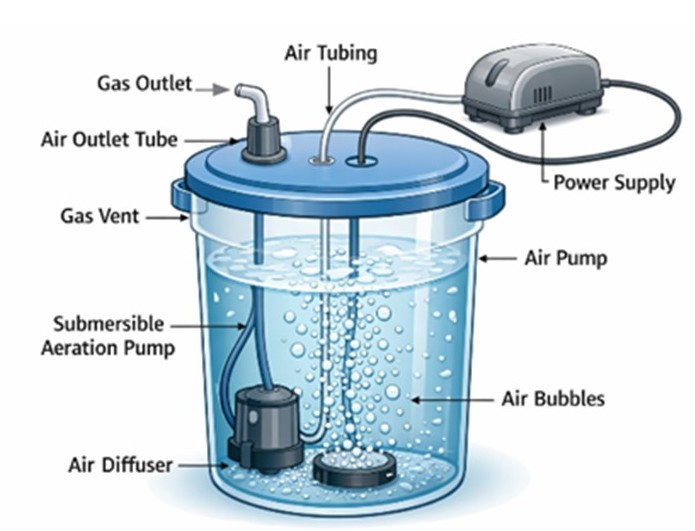
Biological treatment of ammonia requires sufficient carbon availability to maintain stable microbial activity and sustain optimal degradation rates. This study evaluates the kinetics of ammonia biodegradation using an EM4 microbial consortium supplemented with palm sugar as an external carbon source in aerobic batch reactors. Initial ammonia concentrations of 10, 30, and 50 ppm were evaluated over six days of operation. Monitored parameters included ammonia concentration, pH, and biomass (MLSS), while kinetic evaluation applied a pseudo–first‑order model via the ln(St/S0)–time relationship. The results showed removal efficiencies of 79.0–83.4%, accompanied by MLSS increases from ~2,000 to ~4,600 mg/L with higher initial concentrations. The pH range of 5.8–8.5 remained conducive to microbial activity. The ln(St/S0) curves exhibited strong linearity, confirming the suitability of the pseudo–first‑order model, and the reaction rate constants increased under higher substrate and biomass conditions. These findings indicate that palm sugar is effective as an external carbon source for sustaining process stability and accelerating ammonia removal. The integration of EM4 with a natural carbon source demonstrates potential as an efficient, economical, and readily implementable biological approach for ammonia treatment in wastewater.
Downloads
References
S. Ghavam, M. Vahdati, I. A. Wilson, dan P. Styring, “Sustainable ammonia production processes,” Front. Energy Res., vol. 9, hal. 580808, 2021.
D. R. MacFarlane et al., “A roadmap to the ammonia economy,” Joule, vol. 4, no. 6, hal. 1186–1205, 2020.
A. Saeed dan B. Parnum, “Ammonia – an assessment of potential environmental impacts including prevention and mitigation measures,” Aust. Energy Prod. J., vol. 64, no. 2, hal. S512–S515, Mei 2024, doi: 10.1071/EP23141.
T. M. Edwards, H. J. Puglis, D. B. Kent, J. L. Durán, L. M. Bradshaw, and A. M. Farag, “Ammonia and aquatic ecosystems – A review of global sources, biogeochemical cycling, and effects on fish,” Sci. Total Environ., vol. 907, hal. 167911, 2024, doi: https://doi.org/10.1016/j.scitotenv.2023.167911.
M. Farghali et al., “Strategies for ammonia recovery from wastewater: a review,” Environ. Chem. Lett., vol. 22, no. 6, hal. 2699–2751, 2024.
M. Al-Irsyad, E. R. Ngaini, D. Kustono, dan A. Hapsari, “Efektivitas Kombinasi Pistia Stratiotes dan Effective Microorganism 4 (EM-4) sebagai Bioremediator dalam Menurunkan Kadar Amonia Limbah Cair Sentra Pengasapan Ikan,” Sport Sci. Heal., vol. 5, no. 4, hal. 464–474, 2023.
E. A. Utomo dan B. Lekatompessy, “Efisiensi Penurunan Kadar Bod Dan Tss Dengan Bakteri Kultur Em4 Pada Air Limbah Rumah Sakit Dengan Sistem Aerasi,” J. TECHLINK, vol. 6, no. 02, hal. 63–69, 2022.
E. Ariyanto, S. Mayasari, dan D. Kharismadewi, “Pengaruh Penambahan Effective Microorganisms-4 Sebagai Biocatalyst Terhadap Peningkatan Konsentrasi Ammonium Sebagai Sumber Pupuk,” Indobiosains, hal. 28–35, 2022.
W. Wang, Z.-Y. Zhao, X. Zhang, Z.-P. You, Z.-J. Huang, dan Y.-Z. Peng, “Effects of external carbon sources on ultimate nitrogen removal performance and microbial community in secondary effluent treating process,” Huan Jing ke Xue= Huanjing Kexue, vol. 43, no. 9, hal. 4717–4726, 2022.
G. Y. Liu, H. Z. Zhang, W. Li, dan X. Zhang, “Advances of external carbon source in denitrification,” Adv. Mater. Res., vol. 518, hal. 2319–2323, 2012.
M. A. Sanjrani, A. Nafees, R. Sakina, dan G. Xue, “A review on application of external carbon sources for denitrification for wastewater treatment.,” 2022.
H. E. Khoo, B. J. Chen, J. Li, X. Li, S. H. Cheng, dan A. Azrina, “Emerging natural and high-phenolic sweet substances: A review.,” Int. Food Res. J., vol. 30, no. 2, 2023.
M. Manurung, O. Ratnayani, dan Y. Ciawi, “Karbon dari Bahan Alam sebagai Adsorben Ramah Lingkungan: Potensi, Tantangan, dan Aplikasinya,” Nata Palemahan J. Environ. Eng. Innov., vol. 2, no. 1, hal. 38–48, 2025.
X. Zhou, Z. Zhang, dan Y. Li, “Ammonium removal from coking wastewater in a pilot‐scale two‐stage aerobic biofilm system: Biokinetic analysis,” Can. J. Chem. Eng., vol. 95, no. 3, hal. 432–439, 2017.
X. Pan et al., “Experimental Research on the Degradation Coefficient of Ammonia Nitrogen Under Different Hydrodynamic Conditions,” Bull. Environ. Contam. Toxicol., vol. 104, no. 2, hal. 288–292, 2020, doi: 10.1007/s00128-019-02781-0.
A. V Ryzhakov, N. A. Kukkonen, dan P. A. Lozovik, “Determination of the rate of ammonification and nitrification in natural water by kinetic method,” Water Resour., vol. 37, no. 1, hal. 70–74, 2010, doi: 10.1134/S0097807810010069.
A. Leejeerajumnean, J. M. Ames, dan J. D. Owens, “Effect of ammonia on the growth of Bacillus species and some other bacteria.,” Lett. Appl. Microbiol., vol. 30, no. 5, hal. 385–389, Mei 2000, doi: 10.1046/j.1472-765x.2000.00734.x.
N. Li, J. Zhao, R. N. Liu, Y. F. Li, dan N. Q. Ren, “Biological fermentative methane production from brown sugar wastewater in a two-phase anaerobic system,” J. Fundam. Renew. Energy Appl, vol. 5, hal. 181, 2015.
J. K. Purba, E. Harteman, dan E. Veronica, “Pengaruh Pemberian Efektivitas Mikroorganisme (EM4) Yang Berbeda Terhadap Kualitas Air Limbah Laundry,” J. Trop. Fish., vol. 17, no. 2, hal. 66–73, 2022.
R. V Tyson, E. H. Simonne, J. M. White, dan E. Lamb, “Reconciling water quality parameters impacting nitrification in aquaponics: the pH levels,” Proc. Fla. State Hortic. Soc., vol. 117, hal. 79–83, Jan 2004.
M. Henze, M. C. M. van Loosdrecht, G. A. Ekama, dan D. Brdjanovic, Biological wastewater treatment. IWA publishing, 2008.
C. P. L. Grady Jr, G. T. Daigger, N. G. Love, dan C. D. M. Filipe, Biological wastewater treatment. CRC press, 2011.
A. Metcalf & Eddy, Wastewater engineering treatment and resource recovery. McGraw-Hill Education., 2014.
T. Gutiérrez-Macías, P. Mijaylova Nacheva, A. Esquivel-Sotelo, L. García-Sánchez, dan E. B. Estrada-Arriaga, “Batch kinetic studies of pharmaceutical compounds removal using activated sludge obtained from a membrane bioreactor,” Water, Air, Soil Pollut., vol. 233, no. 2, hal. 36, 2022.
B. Hooshyari, A. Azimi, dan N. Mehrdadi, “Kinetic analysis of enhanced biological phosphorus removal in a hybrid integrated fixed film activated sludge process,” Int. J. Environ. Sci. Technol., vol. 6, no. 1, hal. 149–158, 2009.
Copyright (c) 2026 Denanda Clarasati Puteri, Rizky Ibnufaatih Arvianto, Suhirman Suhirman, Adna Ivan Ardian, Muhamad Iqbal Putra, Muhammad Zulfikar Luthfi, Ihsan Wiratama, Jerry Jerry, Dennis Farina Nury

This work is licensed under a Creative Commons Attribution-ShareAlike 4.0 International License.
 This work is licensed under a Creative Commons Attribution-ShareAlike 4.0 International License. Copyright is retained by the authors, and articles can be freely used and distributed by others.