Synthesis and Characterization of Carbon Dots (C-Dots) Derived from Tofu Dregs using Solvothermal Method

-
 Siti Nurhalimah(1*)
 Indonesian Defense University
-
Anggi Khairina Hanum Hasibuan(2)
Department of Chemistry, Faculty of Military Mathematics and Natural Sciences, Universitas Pertahanan Republik Indonesia, Bogor
-
Yusuf Bramastya Apriliyanto(3)
Department of Chemistry, Faculty of Military Mathematics and Natural Sciences, Universitas Pertahanan Republik Indonesia, Bogor
-
Heriyandi Heriyandi(4)
Forensic Laboratory Center, Criminal Investigation Agency of the Indonesian National Police, Bogor
-
Bagas Putra Arfyansyah(5)
Forensic Laboratory Center, Criminal Investigation Agency of the Indonesian National Police, Bogor
(*) Corresponding Author
Abstract
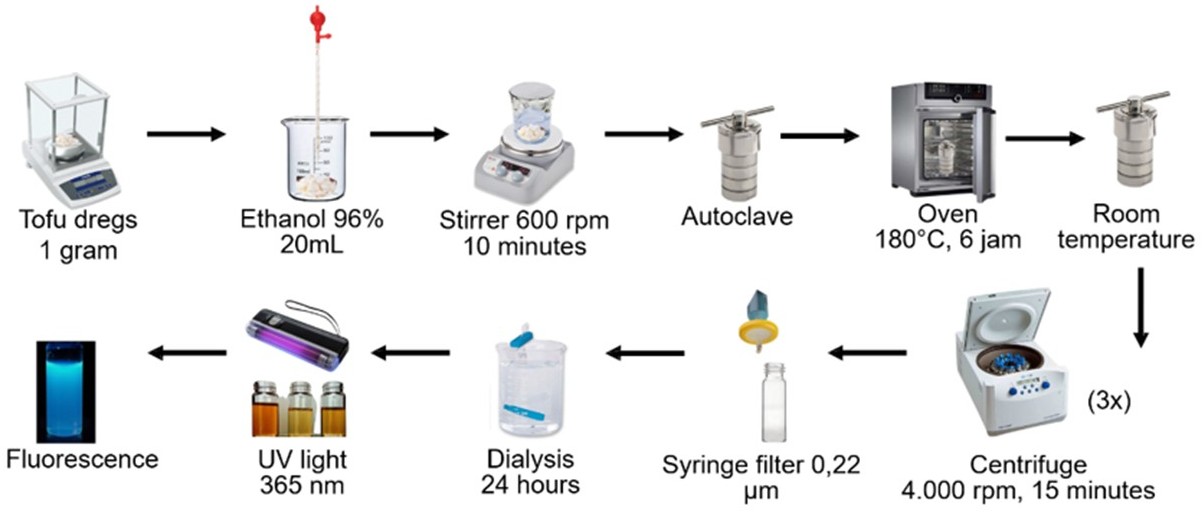
Tofu dregs are an agroindustrial organic byproduct generated in large quantities and still contain carbon-rich compounds such as carbohydrates, proteins, and lipids. This carbon content makes tofu dregs a promising alternative precursor for the synthesis of value-added carbon-based materials, one of which is carbon dots (C-Dots). This study aims to synthesize C-Dots derived from tofu dregs using a solvothermal method and to characterize the optical properties, functional groups, morphology, and elemental composition of the resulting material. The synthesis of C-Dots was carried out using a solvothermal process involving heating in a closed system using tofu dregs and 96% ethanol as the solvent. Characterization was performed using UV–Visible (UV–Vis) spectrophotometry, Fourier Transform Infrared–Attenuated Total Reflectance (FTIR–ATR), and Scanning Electron Microscopy coupled with Energy Dispersive X-ray Spectroscopy (SEM–EDX). The UV–Vis analysis revealed an absorption band at approximately 451 nm, which is associated with π→π* electronic transitions in conjugated carbon structures, as well as a shoulder around 524 nm that can be attributed to n→π* transitions originating from lone pair electrons in oxygen-containing functional groups. FTIR analysis indicated the presence of O–H/N–H, C–H, C=C, C–O/C–O–C, and C–N functional groups on the surface of the C-Dots. Meanwhile, SEM analysis showed agglomerated particle morphology, and EDX results confirmed that the main constituent elements of the material are carbon (C), oxygen (O), and nitrogen (N). The results of this study demonstrate that tofu dregs have strong potential to be utilized as a biomass-derived precursor in the solvothermal synthesis of C-Dots.
Downloads
References
E. Kurniawansyah, A. Fauzan, dan M. Mustari, “Dampak Sosial dan Lingkungan Terhadap Pencemaran Limbah Pabrik,” Civ. Pendidikan-Penelitian-Pengabdian Pendidik. Pancasila dan Kewarganegaraan, vol. 10, no. 1, hal. 14, Mar 2022, doi: 10.31764/civicus.v10i1.9658.
H. Yani, M. A. Y. P. Pagala, dan S. Siadina, “Analisis pendapatan Ampas tahu Didesa sugihwaras kecamatan wonomulyo kabupaten polewali mandar,” J. Agroterpadu, vol. 2, no. 1, hal. 54, Apr 2023, doi: 10.35329/ja.v2i1.3724.
Novela Yaluwo dan Yafet Wetipo, “Implementasi Produksi Bersih Pada Industri Tahu,” J. Int. Multidiscip. Res., vol. 2, no. 7, hal. 230–233, Jul 2024, doi: 10.62504/jimr778.
F. Rindiani, . S., dan . Y., “Pengolahan Limbah Tahu Menjadi Biogas Sebagai Inovasi Guna Mengatasi Krisis Energi,” J. Pendidikan, Sains Dan Teknol., vol. 2, no. 2, hal. 946–951, Des 2023, doi: 10.47233/jpst.v2i2.1304.
N. K. Khairol Anuar, H. L. Tan, Y. P. Lim, M. S. So’aib, dan N. F. Abu Bakar, “A Review on Multifunctional Carbon-Dots Synthesized From Biomass Waste: Design/ Fabrication, Characterization and Applications,” Front. Energy Res., vol. 9, Apr 2021, doi: 10.3389/fenrg.2021.626549.
H. Jing et al., “Green Carbon Dots: Synthesis, Characterization, Properties and Biomedical Applications,” J. Funct. Biomater., vol. 14, no. 1, hal. 27, Jan 2023, doi: 10.3390/jfb14010027.
C. N. Rahmi, S. Sugiarti, dan A. D. Yuliani, “Karbon dots (C-dots) dari Bahan Hayati untuk Deteksi Logam Berat,” ALCHEMY J. Penelit. Kim., vol. 19, no. 2, hal. 234, Mei 2023, doi: 10.20961/alchemy.19.2.61881.234-246.
A. Salvi, S. Kharbanda, P. Thakur, M. Shandilya, dan A. Thakur, “Biomedical application of carbon quantum dots: A review,” Carbon Trends, vol. 17, hal. 100407, Des 2024, doi: 10.1016/j.cartre.2024.100407.
Y. Huo, S. Xiu, L.-Y. Meng, dan B. Quan, “Solvothermal synthesis and applications of micro/nano carbons: A review,” Chem. Eng. J., vol. 451, hal. 138572, Jan 2023, doi: 10.1016/j.cej.2022.138572.
S. Varadharajan, K. S. Vasanthan, V. Mathur, N. Hariperumal, dan N. Mazumder, “Green synthesis and multifaceted applications: challenges and innovations in carbon dot nanocomposites,” Discov. Nano, vol. 19, no. 1, hal. 205, Des 2024, doi: 10.1186/s11671-024-04124-3.
X. Cheng et al., “Mechanism of solvothermal conversion of xylose to furfural in rich-methanol solution: A study based on density functional theory,” J. Anal. Appl. Pyrolysis, vol. 154, hal. 104996, Mar 2021, doi: 10.1016/j.jaap.2020.104996.
Y. Chai, Y. Feng, K. Zhang, dan J. Li, “Preparation of Fluorescent Carbon Dots Composites and Their Potential Applications in Biomedicine and Drug Delivery—A Review,” Pharmaceutics, vol. 14, no. 11, hal. 2482, Nov 2022, doi: 10.3390/pharmaceutics14112482.
M. Jaya, A. Z. Johannes, R. K. Pingak, dan Z. S. Ngara, “Analisis Spektrum Serapan Dan Photoluminesens Karbon Nanodots ( K-Dots ) Berbasis Sekam Padi Asal Kabupaten Kupang,” J. Fis. Fis. Sains dan Apl., hal. 102–109, 2021.
V. B. Kumar, S. K. Mirsky, N. T. Shaked, dan E. Gazit, “High Quantum Yield Amino Acid Carbon Quantum Dots with Unparalleled Refractive Index,” ACS Nano, vol. 18, no. 3, hal. 2421–2433, Jan 2024, doi: 10.1021/acsnano.3c10792.
H. Ding, X.-H. Li, X.-B. Chen, J.-S. Wei, X.-B. Li, dan H.-M. Xiong, “Surface states of carbon dots and their influences on luminescence,” J. Appl. Phys., vol. 127, no. 23, Jun 2020, doi: 10.1063/1.5143819.
H. B. A. Sousa, C. S. M. Martins, dan J. A. V. Prior, “You Don’t Learn That in School: An Updated Practical Guide to Carbon Quantum Dots,” Nanomaterials, vol. 11, no. 3, hal. 611, Mar 2021, doi: 10.3390/nano11030611.
Z. Riahi, A. Khan, M. Ebrahimi, J. Rhim, G. H. Shin, dan J. T. Kim, “Exploring Sustainable Carbon Dots as UV‐Blocking Agents for Food Preservation,” Compr. Rev. Food Sci. Food Saf., vol. 24, no. 3, Mei 2025, doi: 10.1111/1541-4337.70192.
D. Çanakçı, “Synthesis, Spectroscopic, Thermodynamics and Kinetics Analysis Study of Novel Polymers Containing Various Azo Chromophore,” Sci. Rep., vol. 10, no. 1, hal. 477, Jan 2020, doi: 10.1038/s41598-019-57264-3.
D. Zhao et al., “Synthesis of Multicolor Carbon Dots Based on Solvent Control and Its Application in the Detection of Crystal Violet,” Nanomaterials, vol. 9, no. 11, hal. 1556, Nov 2019, doi: 10.3390/nano9111556.
S. Pasieczna-Patkowska, M. Cichy, dan J. Flieger, “Application of Fourier Transform Infrared (FTIR) Spectroscopy in Characterization of Green Synthesized Nanoparticles,” Molecules, vol. 30, no. 3, hal. 684, Feb 2025, doi: 10.3390/molecules30030684.
A. F. Shaikh, M. S. Tamboli, R. H. Patil, A. Bhan, J. D. Ambekar, dan B. B. Kale, “Bioinspired Carbon Quantum Dots: An Antibiofilm Agents,” J. Nanosci. Nanotechnol., vol. 19, no. 4, hal. 2339–2345, Apr 2019, doi: 10.1166/jnn.2019.16537.
W. Matyjasik, K. Matus, O. Długosz, J. Pulit-Prociak, dan M. Banach, “Preparation of Biomass Waste-Derived Carbon Dots by the Thermal Degradation Process,” ACS Omega, vol. 10, no. 22, hal. 22529–22548, Jun 2025, doi: 10.1021/acsomega.4c10119.
P. F. Andrade, G. Nakazato, dan N. Durán, “Additive interaction of carbon dots extracted from soluble coffee and biogenic silver nanoparticles against bacteria,” J. Phys. Conf. Ser., vol. 838, hal. 012028, Jun 2017, doi: 10.1088/1742-6596/838/1/012028.
W. Fawaz, J. Hasian, dan I. Alghoraibi, “Synthesis and physicochemical characterization of carbon quantum dots produced from folic acid,” Sci. Rep., vol. 13, no. 1, hal. 18641, Okt 2023, doi: 10.1038/s41598-023-46084-1.
R. Lamba, Y. Yukta, J. Mondal, R. Kumar, B. Pani, dan B. Singh, “Carbon Dots: Synthesis, Characterizations, and Recent Advancements in Biomedical, Optoelectronics, Sensing, and Catalysis Applications,” ACS Appl. Bio Mater., vol. 7, no. 4, hal. 2086–2127, Apr 2024, doi: 10.1021/acsabm.4c00004.
G. Schinazi, E. J. Price, dan D. A. Schiraldi, “Fire testing methods of bio-based flame-retardant polymeric materials,” in Bio-Based Flame-retardant Technology for Polymeric Materials, Elsevier, 2022, hal. 61–95. doi: 10.1016/B978-0-323-90771-2.00009-2.
F. Fahrullah, D. Kisworo, dan A. Noersidiq, “Karakterisasi Mikrostruktur dan Komposisi Elemental Whey Protein sebagai Bahan Film Biodegradable,” Tarjih Trop. Livest. J., vol. 5, no. 2, hal. 107–115, Des 2025, doi: 10.47030/trolija.v5i2.989.
X. Sun et al., “Tailoring Blue-Green Double Emissions in Carbon Quantum Dots via Co-Doping Engineering by Competition Mechanism between Chlorine-Related States and Conjugated π-Domains,” Nanomaterials, vol. 8, no. 9, hal. 635, Agu 2018, doi: 10.3390/nano8090635.
Copyright (c) 2026 Siti Nurhalimah

This work is licensed under a Creative Commons Attribution-ShareAlike 4.0 International License.
 This work is licensed under a Creative Commons Attribution-ShareAlike 4.0 International License. Copyright is retained by the authors, and articles can be freely used and distributed by others.