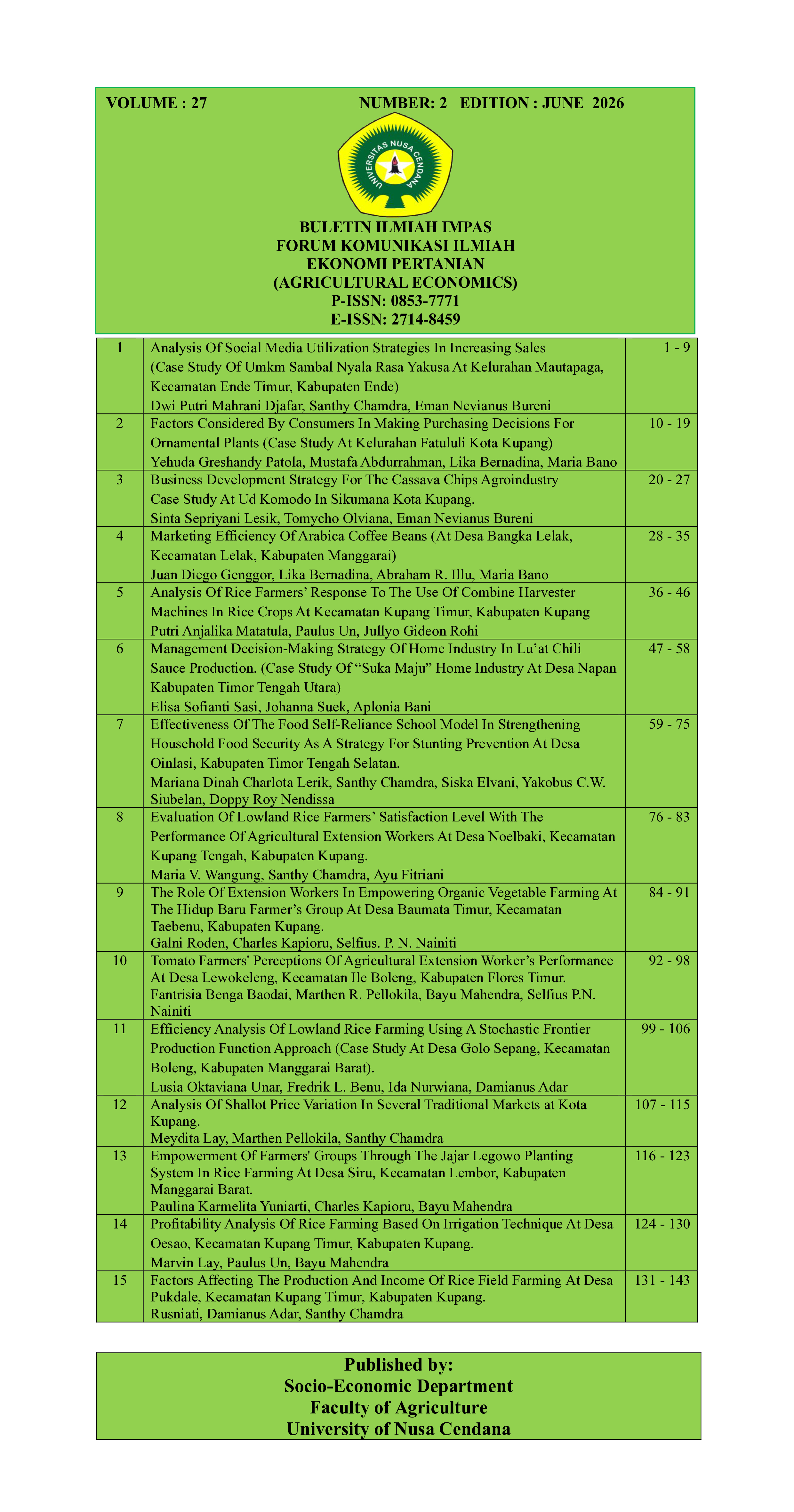
FACTORS CONSIDERED BY CONSUMERS IN MAKING PURCHASING DECISIONS FOR ORNAMENTAL PLANTS (CASE STUDY AT KELURAHAN FATULULI KOTA KUPANG)

-
 Yehuda Greshandy Patola(1*)
 Universitas Nusa Cendana
-
Mustafa Abdurrahman(2)
Universitas Nusa Cendana
-
Lika Bernadina(3)
Universitas Nusa Cendana
-
Maria Bano(4)
Universitas Nusa Cendana
(*) Corresponding Author
Abstract
Kelurahan Fatululi is a center for ornamental plant business actors in NTT. Success in running an ornamental plant business requires an understanding that consumer behavior in purchasing decisions is strongly influenced by socio-economic factors. The selection of the data analysis technique was based on the research objectives, namely: (1) to determine the factors considered by consumers in purchasing ornamental plants, and (2) to determine which factors are most dominant in influencing ornamental plant purchasing decisions. Therefore, the data analysis technique used was descriptive percentage analysis. Based on this study, it can be concluded that price (X1), occupation (X2), plant shape and pattern (X3), types of plants already owned or not yet owned (X4), yard area used (X5), and plant care methods (X6) influence ornamental plant purchasing decisions. This study identified three most dominant factors, namely price (X1), where the largest proportion of respondents selected strongly agree, namely 56.7%, and 43.3% selected agree; plant shape and pattern (X3), where the largest proportion of respondents selected strongly agree, namely 60%, and 40% selected agree; and types of plants already owned or not yet owned (X4), where the largest proportion of respondents selected agree, namely 56.7%, and 43.3% selected strongly agree. Based on these data, it can be concluded that these three factors are more dominant than other factors in this study. Based on the research results and discussion, several conclusions can be drawn as follows: price (X1), occupation (X2), plant shape and pattern (X3), types of plants already owned or not yet owned (X4), yard area used (X5), and plant care methods (X6) influence ornamental plant purchasing decisions. In this study, the three factors that are more dominant in influencing ornamental plant purchasing decisions are price (X1), plant shape and pattern (X3), and types of plants already owned or not yet owned (X4).
Downloads